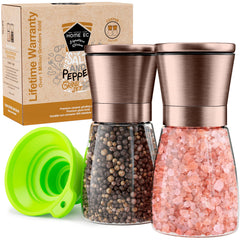
Glass vs Stainless Steel Salt and Pepper Grinder: Which One Actually Belongs on Your Counter?
The question sounds simple — glass or stainless steel? — but it's one of those decisions that follows you every time you cook. You reach for the grinder, you twist, and either you're glad you picked what you picked or you're already thinking about replacing it. The glass vs stainless steel salt and pepper grinder debate comes down to more than looks. It's about how the thing feels in your hand, how long the finish holds up, and whether it still works the same way two years from now as it does on day one.

What Glass Actually Gets Right
Glass has one obvious advantage: you can see exactly how much salt or pepper you have left. No guessing, no shaking it near your ear, no unscrewing the cap to check. That's genuinely useful when you're mid-recipe and don't want a surprise.
Glass bodies also don't absorb flavors or odors over time. If you switch from coarse sea salt to a flavored finishing salt, the grinder stays neutral — no lingering transfer. For anyone who likes cycling through different salts, that matters.
The material itself is inert, which means it won't interact with whatever you're grinding. Salt is corrosive. It doesn't bother glass at all. And in a bright, airy kitchen with light wood tones and white counters, a clear glass grinder has a clean, unfussy look that fits right in.
Where Glass Falls Short
Here's the honest part. Glass grinders break. Not always, not immediately — but drop one on a tile floor and the conversation is over. The body shatters, and you're cleaning up salt and glass shards instead of finishing dinner.
They also tend to feel lighter than they look, which some people read as cheap. The cap threads on glass grinders are often plastic, and those are usually the first thing to fail. Once they strip out, refilling becomes a frustrating exercise and the seal loosens, which lets moisture creep in.
Over time, glass can also cloud slightly from mineral deposits, especially if you're grinding salt in a humid kitchen. It doesn't affect performance, but it dulls that clean look you bought it for.

What Stainless Steel Does Better
Stainless steel grinders are built to take punishment. You can knock one off the counter and pick it up, check for a dent, and keep grinding. The weight feels deliberate — there's a solidity to a good stainless grinder that glass just can't match.
The finishes have gotten genuinely interesting, too. It's not just brushed silver anymore. Copper, gold, gunmetal, matte black — a well-chosen stainless grinder can anchor the look of a whole kitchen, especially if you're already mixing in those tones through your faucet, cabinet hardware, or pendant lights.
Stainless also plays well with heat and steam. A glass grinder sitting near a stovetop is a small but real risk every time you cook with boiling water nearby. Stainless shrugs it off.
The One Stainless Steel Downside Worth Mentioning
You can't see inside. That's it, really. You fill the grinder, use it for a few weeks, and eventually you twist it expecting a full grind and get almost nothing. It's not a dealbreaker — you get used to refilling on a schedule — but if you're the kind of person who likes knowing exactly what's left, it's a real-world inconvenience.
Some stainless grinders solve this with a small window or a partial acrylic body. But in a fully opaque steel grinder, you're working on feel and habit rather than sight.
Which Kitchen Is Each Built For?
Glass grinders tend to thrive in kitchens where the aesthetic leans minimal or Scandinavian — lots of white, natural light, clean lines. They show off what's inside and keep the look light.
Stainless steel grinders belong in kitchens that already have some warmth and texture — dark counters, mixed metals, wood tones, or a more industrial lean. They carry weight without demanding attention, and the finish options mean you can actually match them to the room.
If durability is the deciding factor — and in a household where the counter gets heavy use, it usually is — stainless wins cleanly. Glass is beautiful until it isn't.
Does the Grinding Mechanism Change Between the Two?
The body material and the grinding mechanism are two completely separate things, and this is where a lot of buyers get confused. Whether you go glass or stainless steel on the outside, what's doing the actual work is the burr inside — and ceramic is the one you want regardless of the shell.
Ceramic burrs don't rust, don't dull under normal use, and don't react with salt the way steel burrs can. A glass-bodied grinder with a ceramic mechanism will outperform a stainless grinder with a cheap steel burr every single time. So when you're comparing options, look at what's inside, not just what it looks like from the outside.
The Short Version
Glass is beautiful, practical in its transparency, and works well until something goes wrong. Stainless is more resilient, handles daily abuse without showing it, and gives you more flexibility in how it fits your kitchen's look. Both can grind well — it depends almost entirely on the mechanism inside.
If you're outfitting a kitchen you're serious about, the stainless steel sets with quality ceramic mechanisms are where most people land and stay. And honestly? A matching set in the right finish is one of those small things that makes the whole counter feel pulled together.

Home EC Salt and Pepper Grinder Set 2pk-Short - Gold
A compact stainless set with a warm gold finish — pairs beautifully with brass fixtures or natural wood tones, and the ceramic mechanism keeps the grind consistent from the first use to the hundredth.
Shop Now →
Home EC Salt and Pepper Grinder Set 2pk-Short - Gun Metal Bronze
If your kitchen runs dark — slate counters, matte black hardware, moody tones — this gunmetal bronze set fits right in without trying too hard. Durable stainless body, ceramic burr, and a finish that doesn't scuff easily.
Shop Now →Related Posts
The Best Salt and Pepper Grinder Gift Set for Every Person on Your List

Glass Salt and Pepper Grinders: What to Look For, What to Avoid, and Which Ones Are Worth It