The Best Salt and Pepper Grinder for Arthritis: What Actually Makes a Difference
If twisting a standard pepper grinder leaves your hands aching, you're not being dramatic — most grinders are genuinely designed without joint pain in mind. The good news is that the best salt and pepper grinder for arthritis doesn't require you to sacrifice freshness or flavor. It just requires knowing which features actually reduce strain, and which are marketing fluff that won't help you at all.
Why Standard Grinders Are Hard on Your Hands
Most traditional pepper grinders use a twist mechanism that demands a firm grip and repetitive rotation. For someone with healthy hands, that's a minor inconvenience. For anyone dealing with arthritis, rheumatoid or osteo, those same motions can be genuinely painful — especially first thing in the morning when stiffness is at its worst.
The problem isn't usually the grinding mechanism itself. It's the combination of a narrow body that's hard to hold, a stiff adjustment knob that requires pinching, and a twist action that puts torque directly on already-inflamed joints. A few design tweaks change everything.
The Features That Actually Reduce Strain
Body Diameter and Shape
A wider, taller body is dramatically easier to grip. You engage more of your palm instead of relying on finger strength alone. This is one reason tall grinder sets tend to work better for people with arthritis than shorter, stubbier models — more surface area means less pinching, less grip force, and less fatigue over time.
Textured surfaces or faceted designs help too. They give your hand something to hold onto without requiring a death grip, which matters more than most people realize until they've tried both side by side.
Grinding Resistance
A smooth, well-calibrated ceramic burr mechanism makes a real difference. Cheap grinders fight you — the burrs grind unevenly, you have to apply extra force to get anything out, and the whole experience becomes a workout. A quality ceramic burr set at a medium coarseness should spin with minimal resistance. You want the mechanism doing the work, not your knuckles.
Coarser settings also grind easier than fine ones. If you're managing joint pain, grinding at a medium-coarse setting takes noticeably less effort than cranking all the way down to a fine powder grind.
Top Cap Design
This one's overlooked constantly. The adjustment knob at the top of most grinders is small, requires pinching, and often demands significant twisting force to change settings. Look for a grinder where the top cap is wide enough to turn with your whole hand rather than just your fingertips. Some sets have metal-topped caps with a broader profile — those are far friendlier for arthritic hands than a narrow plastic nut.

Tall vs. Short: Which Works Better for Arthritis?
Tall grinders consistently win here. The extra height gives you more leverage — you're not just gripping the body, you're stabilizing it against your palm as you twist. That mechanical advantage means less effort per rotation, which adds up fast when you're seasoning a whole pot of soup.
Shorter grinders aren't useless, but they do require more concentrated finger and wrist force. If you're choosing between sizes specifically for comfort, tall is the clear answer.

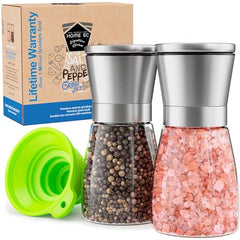
Home EC Salt and Pepper Grinder Set 4pk - Short
A four-pack of compact grinders with smooth ceramic burr mechanisms — ideal if you prefer keeping a pair at the table and another at the stove, with enough grip surface to use comfortably even on difficult days.
Shop Now →Does a Set Make More Sense Than a Single Grinder?
For most households, yes. Having both a salt grinder and a pepper grinder means you're not switching between the same vessel mid-cook — you just pick up the one you need. Less fumbling, less grip switching, less strain overall. A matched set also keeps things consistent; you know both grinders have the same resistance level and the same body shape, so there's no adjustment period.
If your hands are particularly sensitive, a two-pack with tall bodies in a copper or gunmetal finish also gives you a bit more grip than the standard clear acrylic — the metal top cap has a different tactile quality that most people find easier to hold securely.

Home EC Salt and Pepper Grinder Set 2pk-Short - Copper
The warm copper-finish top cap adds a bit of extra grip surface and heft, and the ceramic burr mechanism turns smoothly without requiring a lot of force — two things that matter a lot when your hands aren't cooperating.
Shop Now →A Few Other Things Worth Knowing
Keep the Coarseness Setting Consistent
Every time you adjust the coarseness, you're twisting the top cap — usually with your fingertips, which is the hardest motion for arthritic hands. Pick a setting you're happy with and leave it. Most cooks land on a medium-coarse grind for everyday seasoning, and that works well for pasta, eggs, salads, and most roasted dishes without ever needing to change it.
Don't Overfill
A full grinder is heavier and requires slightly more torque to turn. Fill it to about two-thirds capacity. It sounds like a small thing, but when you're grinding over a hot pan and your wrists are already tired, the difference between a full and a two-thirds-full grinder is real.

Ceramic Burrs Are Easier Than Steel
Ceramic grinding mechanisms tend to turn more smoothly than carbon steel ones, particularly at medium-coarse settings. They don't rust, they don't seize up, and they don't require as much breaking-in time. For anyone prioritizing ease of use, ceramic is the right call — full stop.
What to Look for at a Glance
You want a tall body — not short — with a wider diameter than the bargain-bin options. A metal-capped top that you can grip with your whole hand, not just two fingers. A ceramic burr mechanism set to medium-coarse, so the resistance is low. And ideally a matched salt-and-pepper set so you're not picking up and putting down the same grinder twice every time you cook.
The best salt and pepper grinder for arthritis isn't some specialized medical device. It's just a well-designed grinder that someone with healthy hands might also reach for because it's comfortable, smooth, and good-looking on the counter. That's a pretty reasonable bar — and it's easier to meet than most people expect.
Related Posts
How to Adjust the Coarseness on a Pepper Grinder (And Why It Actually Matters)

How to Refill a Salt and Pepper Grinder (Without the Mess or the Guesswork)