Electric vs Manual Salt and Pepper Grinder: Which One Actually Belongs in Your Kitchen?
It sounds like a small decision. Electric or manual — how much could it really matter? Turns out, more than you'd think. The debate over electric vs manual salt and pepper grinder comes down to more than convenience. It touches on how you cook, how you set your table, and honestly, what kind of experience you want every time you season a dish. Both types work. But they don't work the same way, and the right choice depends entirely on you.

What's Actually Different Between Electric and Manual Grinders?
At the most basic level, a manual grinder requires you to twist — usually the top or bottom of the mill — while an electric grinder does the turning for you with the press of a button. Simple enough. But the implications of that difference ripple outward in ways people don't always anticipate before they buy.
Manual grinders give you tactile control. You feel the resistance of the mechanism, you control the pace, and you can adjust coarseness by tightening or loosening the grinding burr. It's an active, engaged process. Electric grinders remove all that — you just point and press, which is genuinely useful when you're mid-cook and your other hand is holding a pan handle.
Neither is objectively better. They solve different problems for different cooks.
The Case for a Manual Grinder
Manual grinders have been around forever, and there's a reason they haven't been replaced. They're simple, reliable, and don't require batteries or a charge. You pick one up, you twist, you get freshly ground salt or pepper. That's it.
There's also something satisfying about the ritual. Grinding pepper at the table feels intentional. It's the kind of small moment that makes a meal feel more considered, even if you're just eating pasta on a Tuesday night.
On the practical side, manual grinders tend to be quieter, lighter, and easier to clean. They don't have motors to worry about or battery compartments that corrode if you forget about them for six months. And because they don't rely on torque from a motor, the ceramic grinding mechanisms in quality manual mills can last years without losing performance.

The downside? If you're seasoning a large batch of food — a whole roast, a big pot of soup, a sheet pan full of vegetables — manual grinding can feel tedious. Your wrist will let you know.
The Case for an Electric Grinder
Electric grinders shine in exactly the moments where manual ones slow you down. One-handed operation is the big one. If you're stirring a sauce with one hand and need to season with the other, an electric mill handles it without you having to set anything down. That's a genuinely useful quality in a busy kitchen.
They're also faster, which matters more than it sounds when you're prepping a large dinner and going through a lot of pepper. Some electric models also include built-in lights so you can see exactly how much you're grinding — a small feature that turns out to be surprisingly handy.
The tradeoffs are real, though. Batteries die, usually at the worst possible moment. Electric grinders are heavier and bulkier than their manual counterparts. And they tend to cost more, both upfront and in ongoing battery replacement. If the motor goes, the whole unit goes — there's no simple fix.
Coarseness Control: Does One Win Here?
This is where a lot of people have questions, and it's worth being specific. High-quality manual grinders — ones with ceramic or carbon steel burrs — offer exceptional coarseness control. A simple adjustment at the top or bottom of the mill shifts you from fine powder to coarse cracked peppercorns in seconds.
Electric grinders vary more here. Budget electric options often have limited coarseness settings, sometimes just two or three fixed positions. Mid-range and premium electric models get closer to the control a good manual mill offers, but you're paying for that precision. If coarseness variety matters to you — and it should, because coarse black pepper on a steak is a completely different thing than fine-ground pepper in a vinaigrette — a quality manual grinder often gives you more for less money.
What About the Look on Your Table?
Let's be honest: table presence matters. A grinder sitting on your counter or dining table is part of the visual experience of a meal. Electric grinders tend to look more utilitarian — they're wider, more cylindrical, and unmistakably mechanical. Manual mills have centuries of design history behind them, which is why they tend to look more elegant in a range of finishes.
If you want something that looks as good as it functions, a well-designed manual set in a finish that matches your kitchen — gold hardware against light wood, gunmetal against a dark countertop — is hard to beat.

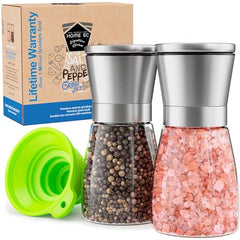
Home EC Salt and Pepper Grinder Set 2pk-Short — Gold
A compact manual set with warm gold hardware that earns its place on any counter. Adjustable ceramic burrs let you go from fine to coarse without fiddling with complicated settings.
Shop Now →
Home EC Salt and Pepper Grinder Set 2pk-Short — Gun Metal Bronze
The gunmetal bronze finish gives these short mills a slightly moody, modern look that works just as well on a casual weeknight table as it does when you're hosting. Adjustable grind, durable build, no batteries required.
Shop Now →So Which One Should You Actually Buy?
Here's the honest answer: for most home cooks, a high-quality manual grinder does everything you need and then some. It's quieter, more precise, better-looking on a table, and doesn't have a single battery to replace. The only thing it asks is a few turns of your wrist — which, for the quality of pepper you get in return, is an easy trade.
Electric grinders make more sense if you cook in high volume regularly, have limited hand strength or dexterity, or genuinely love the convenience of one-button operation. They're not wrong. They're just solving a slightly different problem.

The real mistake would be sticking with pre-filled shakers of ground spice when either option — electric or manual — gives you something so much better. Freshly ground pepper has a brightness and heat that fades fast once it leaves the mill. Freshly ground salt has texture and presence that a pre-filled shaker simply can't replicate.
Pick the style that fits how you cook. Load it up with whole peppercorns and coarse sea salt. Then actually use it — on everything, every day. That's when the difference stops being theoretical and starts showing up in every single plate you put on the table.
Related Posts

How to Refill a Salt and Pepper Grinder (Without the Mess or the Guesswork)
How to Clean a Salt and Pepper Grinder (The Right Way, Without Wrecking It)