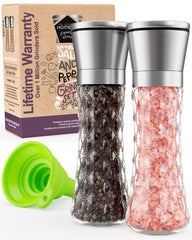
Gravity vs Adjustable Salt and Pepper Grinder: Which Mechanism Is Right for You?
It's one of those decisions that sounds straightforward until you start looking into it. Gravity vs adjustable salt and pepper grinder — two different mechanisms, two different experiences, and a real difference in how you season your food day to day. Neither one is wrong. But one of them is probably better suited to the way you actually cook.

Understanding the difference takes about five minutes. Making the right call could mean years of smooth, frustration-free grinding instead of constantly fiddling with a mechanism that wasn't built for how you use it.
What Is a Gravity Grinder, Exactly?
A gravity grinder — sometimes called a one-handed or tilt-to-grind grinder — works exactly the way its name suggests. You flip it upside down (or tilt it at an angle), and the act of holding it over your food activates the grinding mechanism automatically. No twisting required. The weight of the contents engages the grinder, you get your seasoning, and you set it back down right-side-up when you're done.
The appeal is obvious. If you're mid-cook, one hand on a pan, the other reaching for a grinder — gravity does the work. It's fast, it's almost effortless, and there's a certain satisfaction to the whole motion once you get used to it.
The trade-off? You typically get less control over grind coarseness. Most gravity grinders are set to a fixed grind size, or offer very limited adjustment. That works perfectly well for everyday seasoning. But if you want a fine dust for a delicate sauce or coarse cracked pepper for a steak crust, a gravity model probably won't give you that range.
How Adjustable Grinders Work (And Why That Matters)
An adjustable grinder — which is the mechanism most kitchen grinders use — lets you control exactly how coarse or fine your grind comes out. Usually there's a dial or screw at the top of the mechanism that you set before grinding. Tighten it for a fine powder; loosen it for larger, more rustic pieces.
This is the type of grinder you're most likely familiar with. You twist the top or bottom of the mill, and the ceramic or stainless steel burrs inside do the work. The grinding happens through manual rotation, not gravity.

What you get in return for that extra step is real flexibility. Fine salt for finishing a pasta dish. Medium pepper for an omelette. Coarse cracked peppercorns pressed into a piece of salmon before it hits the pan. An adjustable grinder handles all of it — you just dial in what you need before you grind.
The slight downside is that two-handed operation. You're holding the grinder body with one hand and twisting with the other, which is a minor inconvenience most people don't even think about. Until they try a gravity model and realize how quick it is.
Which One Is Better for Everyday Home Cooking?
Honestly? It depends on your kitchen habits more than anything else.
If you season simply — salt and pepper, consistent amounts, no need to switch between fine and coarse throughout a single cooking session — a gravity grinder fits right into that routine. You're not missing anything by skipping the adjustability. The convenience of one-handed operation is genuinely useful when you're juggling multiple things at once on a busy weeknight.
But if you cook with any real range — if you bake, if you do dry rubs, if you finish dishes with flaky salt or cracked pepper as a texture element — you'll notice the limitation. A gravity grinder isn't going to give you that kind of control, and you'll find yourself wishing you could adjust on the fly.
For most home cooks, an adjustable grinder wins on versatility. It's the more forgiving choice, and it covers more ground without asking you to compromise.
What About Grind Consistency?
This is where the mechanism matters less than the quality of the burrs inside. Both gravity and adjustable grinders can produce consistent grinds — if they're built well. Ceramic burrs hold up better over time and don't transfer metallic taste to your food. Stainless steel is durable but can corrode if moisture gets into the mechanism regularly (a real risk with salt).
A cheap gravity grinder will grind inconsistently. A cheap adjustable grinder will too. The type of mechanism isn't what determines grind quality — the construction does. That's why it's worth spending a little more on a grinder set that's built to last rather than replacing a $10 mill every year.


Home EC Salt and Pepper Grinder Set 2pk-Tall Gold Top
A sleek adjustable pair with a warm gold finish — the ceramic mechanism lets you dial between fine and coarse with a simple turn, and the tall body holds enough to go weeks between refills.
Shop Now →Can You Get the Best of Both Worlds?
Some people do. They keep a gravity grinder within arm's reach of the stove for quick, everyday seasoning, and an adjustable mill for more deliberate cooking. It's not a bad setup if counter space isn't an issue and you genuinely cook at both ends of the spectrum.
But if you're looking for one set that does it all well, an adjustable grinder is the smarter starting point. You can always grind more than you need; you can't conjure coarseness from a grinder that's locked into a single setting.

Home EC Salt and Pepper Grinder Set 4pk - Tall
Four adjustable tall grinders that let you keep salt and pepper at both the stove and the table — each one with a ceramic mechanism and a fully adjustable coarseness dial so you're never stuck with one setting.
Shop Now →The Bottom Line on Gravity vs Adjustable
Gravity grinders are clever, convenient, and genuinely fun to use. If simplicity and speed are your priorities, they're worth a look. But the gravity vs adjustable salt and pepper grinder debate tips toward adjustable for one straightforward reason: flexibility. You get more control, more range, and a mechanism that grows with however your cooking evolves.
A well-built adjustable grinder set, kept on your counter, refilled when it runs low, and dialed to the coarseness that fits whatever you're making — that's about as much as you'd ever ask a grinder to do. And the right one does it every time without a second thought.
Related Posts
Can You Put Himalayan Salt in a Grinder? Yes — But Here's What to Know First
What Salt to Use in a Salt Grinder (And What You Should Never Put in One)