Salt Mill vs Salt Grinder: Is There Actually a Difference?
You've seen both terms on packaging, in product listings, and probably on the side of something sitting on your counter right now. Salt mill vs salt grinder — are they the same thing, or is there a real distinction worth understanding before you buy? The honest answer is: mostly the same, but the details matter depending on what you're grinding and how you're grinding it.

Where the Confusion Comes From
The word "mill" has old-world roots — windmills, grain mills, pepper mills. It carries a certain weight, a sense of something mechanical and considered. "Grinder," on the other hand, sounds more utilitarian, more modern. Neither word is technically wrong, and no governing body has decided which one applies to which device.
In practice, most manufacturers use the terms interchangeably. A salt mill and a salt grinder both use two burrs — one fixed, one rotating — to crush salt crystals between them and release them at whatever coarseness you've dialed in. The mechanism is the same. The physics is the same. Only the label differs.
That said, there are a few soft conventions worth knowing about, especially if you're shopping carefully.
When "Mill" Usually Means Something Specific
In traditional European kitchenware, a mill often refers to a wooden-bodied grinder — the tall, tapered style you'd find at a French bistro. Think lacquered beechwood, a brass mechanism inside, and a satisfying resistance when you twist it. The word "mill" stuck to that aesthetic.
A "grinder," by contrast, tends to describe the broader category — including acrylic, glass, and stainless steel bodies, electric versions, and anything that doesn't look like it came out of a Burgundy kitchen. It's a bigger tent.
So if someone says "salt mill" and you picture something wooden and classic, you're not wrong. But if a stainless steel grinder calls itself a mill on the box, it's not lying to you either. The terminology is loose by design.

Does the Name Tell You Anything About Quality?
Not really. This is the part where the salt mill vs salt grinder distinction breaks down completely. You can find cheap plastic grinders that jam in two weeks and hand-turned wooden mills that last fifteen years — and vice versa. The label on the box doesn't tell you how the mechanism is built or what it's made of.
What actually determines quality is the burr material (ceramic holds up better than steel for salt, because salt is corrosive) and the tightness of the coarseness adjustment. A grinder with a loose, wiggly dial will drift over time and produce inconsistent results. A well-machined mechanism — ceramic burrs, a solid adjustment ring — will grind the same way on year three as it did on day one.
Body material matters for looks and durability, but the mechanism is the part doing the work. Always.
Which Salt Types Work Best in a Grinder or Mill?
Here's where the practical conversation gets interesting. Not every salt belongs in a grinder. Fine table salt, for instance, doesn't need one — it flows freely from a shaker and grinding it finer doesn't add anything. What you want in a grinder is something with actual texture and structure.
Himalayan pink salt and coarse sea salt are the two most common choices, and both work beautifully. They're hard enough to grind cleanly without turning to powder immediately, and crushing them fresh releases trace minerals and a subtly different flavor than pre-ground salt straight from a box. Rock salt works too, though it's harder on mechanisms and benefits from a ceramic burr over a steel one.
Whatever you call the device — mill or grinder — the logic is the same: whole crystals, ground fresh, taste noticeably better than something that's been sitting pre-ground in a container for months.

Home EC Salt and Pepper Grinder Set 2pk-Tall — Copper
The warm copper finish on these tall grinders looks striking on a counter, and the ceramic mechanism inside handles Himalayan pink salt and coarse sea salt without skipping a beat. Adjustable coarseness, built to last.
Shop Now →So Which Term Should You Actually Search For?
When you're shopping, use both. Searching "salt grinder" will return far more results — it's the more commonly used term in product listings, especially from American brands. "Salt mill" tends to surface more traditional or European-style options, including wooden-bodied versions with a classic profile.
If you're after something with a modern finish — stainless steel, copper, gunmetal, glass — search "salt grinder." If you want something with that old-school wooden aesthetic, "salt mill" is the better search term. Either way, you're looking for the same core thing: a reliable ceramic or hardened steel mechanism that grinds consistently and a body that won't feel hollow in your hand.

One More Thing Worth Knowing About Grinder Sets
Most people buying a salt grinder also need a pepper grinder. Buying them as a matching set isn't just about aesthetics — it means the mechanisms are built to the same spec, the bodies are identical in weight and height, and they'll wear evenly over time. A mismatched pair looks fine until it doesn't, and the weight difference between two different brands gets noticeable fast.
A set also typically costs less than two individual grinders bought separately. That's worth factoring in before you go hunting for singles.

Home EC Salt and Pepper Grinder Set 2pk-Tall — Green
A deep green finish that stands out without trying too hard, paired with a ceramic mechanism that handles everything from fine sea salt to coarse Himalayan crystals. Both grinders are built identically so they wear, balance, and age the same way.
Shop Now →The Short Version
A salt mill and a salt grinder are the same device with different marketing language attached. The word "mill" has older, more artisanal connotations; "grinder" is the broader, more modern term. Neither tells you much about build quality on its own.
What tells you about quality is what's inside — the burr material, the coarseness mechanism, and how the body feels when you pick it up. A grinder that costs $14 with a plastic burr will give you a different experience than one with a ceramic mechanism and a body that doesn't flex under pressure. The name on the label has nothing to do with that difference.
Call it whatever you want. Just make sure the mechanism is worth buying.
Related Posts
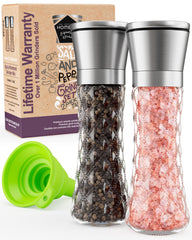
Why a Ceramic Salt and Pepper Grinder Beats Every Other Kind
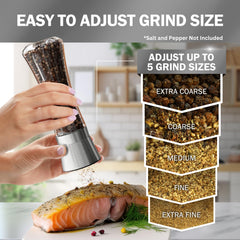
The Best Salt and Pepper Grinder Gift Set for Every Person on Your List