Can You Put Himalayan Salt in a Grinder? Yes — But Here's What to Know First
It's one of those questions that seems obvious until you actually think about it. You've got a beautiful bag of pink Himalayan salt sitting on the counter, a grinder that needs filling — so, can you put Himalayan salt in a grinder? The short answer is yes. But there's enough nuance here that getting it wrong could shorten your grinder's life considerably, or leave you with a frustrating, clumpy grind every single time.

Why Himalayan Salt and Grinders Are Actually a Good Match
Himalayan salt comes in large, coarse, irregular crystals — and that's a feature, not a flaw. Ceramic burr grinders are designed exactly for this. The burrs grip chunky, angular crystals and crush them down to whatever coarseness you've dialed in. Fine table salt, by contrast, often slips straight through the mechanism without making real contact, which is one reason it's a poor grinder choice.
Himalayan salt is also naturally dry, which matters a lot. Moisture is what kills grinders over time — it causes salt to clump, jams the mechanism, and eventually corrodes anything metal inside. Because Himalayan salt has very low moisture content, it flows through a quality grinder without caking or binding up.
The mineral content is slightly different from standard sea salt, but not in any way that affects your grinder mechanically. The pink color comes from trace iron oxide — it won't stain ceramic burrs or degrade the mechanism. You're safe on that front.
The One Thing That Can Actually Go Wrong
Here's where people run into trouble: crystal size. Himalayan salt sold for grinders is usually pre-sized to somewhere between 2–8mm — coarse enough to grind well, small enough to load into a standard fill chamber. But some bags, especially culinary-grade blocks or decorative salts, contain crystals that are simply too large to fit through the grinder's inlet or to process efficiently.
If you try to force oversized crystals into a grinder not built for them, you'll either jam the mechanism or get an extremely uneven output — half dust, half barely-cracked chunks. Neither is useful over a plate of food.
The fix is simple: check the label before you buy. Look for Himalayan salt specifically labeled "for grinders" or "coarse grind." That sizing is intentional and will work exactly as expected with a standard ceramic burr mechanism.

Does Himalayan Salt Actually Taste Different When Freshly Ground?
This is worth talking about, because it's the whole reason you'd bother with a grinder in the first place. Pre-ground Himalayan salt loses some of its aromatics and that subtle mineral edge during processing and packaging. Freshly ground salt, cracked right over a hot dish, releases those compounds all at once. It's noticeably brighter. More present.
It's the same logic as whole peppercorns versus pre-ground pepper. The moment you crush it, flavor starts to dissipate. Keeping your salt in coarse crystal form and grinding it fresh preserves that clean, slightly complex finish that makes Himalayan salt worth choosing over regular table salt in the first place.
What Type of Grinder Works Best with Himalayan Salt
You need a ceramic burr grinder. Full stop. Metal burrs and Himalayan salt are a genuinely bad combination — the salt will accelerate corrosion over time, especially if there's any moisture involved. Ceramic is non-reactive, doesn't rust, and stays sharp far longer than metal alternatives.
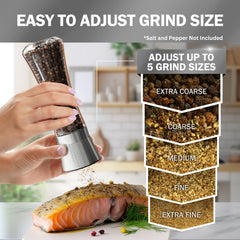
The grinder also needs an adjustable coarseness setting. Himalayan salt is often used as a finishing salt, where you want a coarser, flakier texture on top of a dish. For cooking or seasoning mid-recipe, you might want something finer. A fixed grind setting limits you in ways that get annoying fast.

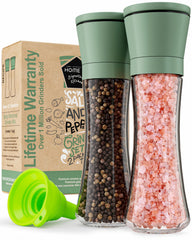
Home EC Salt and Pepper Grinder Set 2pk-Tall — Gunmetal Top ($27.99)
Ceramic burr mechanism, adjustable coarseness, and a sleek gunmetal finish that looks sharp on any counter — exactly what you want when loading up with coarse Himalayan salt crystals.
Shop Now →Can You Mix Himalayan Salt with Other Salts in the Grinder?
Technically, yes. Practically — don't. Mixing coarse Himalayan crystals with finer salts creates inconsistent crystal sizes inside the chamber, which means the burrs can't grip everything uniformly. You'll end up with an uneven grind: some crystals over-processed into dust, others barely touched. Stick to one salt type per grinder, and you'll get a consistent result every time.
If you want both Himalayan salt and sea salt on the table, that's exactly why grinder sets with two separate bodies exist. One for each type, clearly designated, no mixing.

How to Fill a Grinder with Himalayan Salt Without Making a Mess
Most grinders either unscrew from the top or bottom — check which style yours is before you start. If it's a top-fill design, remove the cap, use a small funnel or fold a piece of parchment into a cone shape, and pour the crystals in slowly. Himalayan crystals are chunky enough that they can pile up at the opening if you rush it.
Don't overfill. Leave about a quarter-inch of space at the top of the chamber so the mechanism can seat properly and the crystals have room to move. A packed-to-the-brim grinder grinds poorly and puts unnecessary strain on the burrs.
And if any crystals spill onto the exterior, brush them off right away — especially around any metal hardware. Even low-moisture salt will do slow damage if it sits against metal long enough.

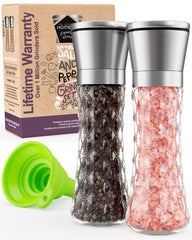
Home EC Salt and Pepper Grinder Set 2pk-Tall — Diamond Facet ($22.99)
The faceted glass body shows off the pink Himalayan crystals beautifully while keeping the ceramic mechanism well-protected — a practical and genuinely attractive pairing.
Shop Now →The Bottom Line on Himalayan Salt and Grinders
Himalayan salt is genuinely one of the best salts you can put in a grinder. It's dry, it's coarse, it's non-reactive with ceramic burrs, and it tastes noticeably better when ground fresh. The only real pitfalls — crystal size and grinder material — are easy to avoid once you know to look for them.
Buy coarse Himalayan salt labeled for grinders, use a ceramic burr mechanism with adjustable settings, and keep the fill chamber at a reasonable level. Do those three things and your grinder will handle Himalayan salt without complaint for a long time.
Related Posts
The Best Salt and Pepper Grinder for Arthritis: What Actually Makes a Difference
The Best Ceramic Burr Pepper Grinder: What to Look For and Why It Matters