The Best Salt for Grinder Use: How to Choose, Fill, and Get a Perfect Grind Every Time
You'd think filling a salt grinder would be the easy part. Buy salt, pour it in, twist the top. But if you've ever dealt with a grinder that seized up halfway through dinner, produced a clumpy uneven shower of salt, or just stopped turning altogether — there's a good chance the salt itself was the problem. Choosing the right salt for grinder use is one of those small decisions that makes a surprisingly large difference in how well your grinder performs over months and years of use.

Why the Type of Salt You Use Actually Matters
Grinders aren't built to handle just anything you pour into them. The ceramic burr mechanism — the grinding element inside most quality grinders — works by crushing dry, angular crystals between two abrasive surfaces. Feed it the wrong salt and you'll fight the grinder every time you reach for it.
The three variables that matter most are crystal size, shape, and moisture content. Get those three things right and the grinder works like it should. Get them wrong and you're looking at clogs, corrosion, or a mechanism that grinds so unevenly you can't control the seasoning at all.
The Best Salts to Put in a Grinder
Himalayan Pink Salt
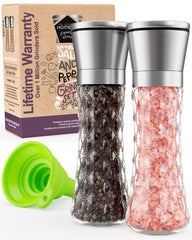
This is probably the most popular choice, and for good reason. Himalayan pink salt comes in large, coarse, angular chunks — exactly the shape a ceramic burr is designed to bite into and crush. It's also naturally very dry, which means it won't clump inside the mechanism or introduce moisture that could cause the burrs to seize.
The flavor is mild and mineral-forward, and those faint pink crystals look beautiful in a clear glass grinder. If you're filling a grinder for the first time and aren't sure where to start, Himalayan pink salt is an excellent default.

Sea Salt (Coarse)
Coarse sea salt — the kind that comes in irregular, chunky flakes or crystals — grinds beautifully too. Atlantic or Mediterranean varieties tend to have a clean, bright flavor that works well on everything from roasted vegetables to a simple piece of fish. Just make sure you're buying the coarse cut, not flaked or fine sea salt (more on those in a moment).
Some coarse sea salts can carry a trace amount of natural moisture from their harvesting process, so if you live somewhere humid, keep an eye on the grinder's performance and refill in smaller batches to keep things fresh.
Rock Salt
Rock salt is another solid option. It's dense, dry, and the large crystal structure handles well in most grinders. The flavor profile is more straightforward than Himalayan or sea salt — less complex, more purely salty — but if you're after reliable seasoning without fuss, it does the job consistently.

Home EC Salt and Pepper Grinder Set 4pk – Tall
Four tall grinders with ceramic burr mechanisms built to crush coarse Himalayan and sea salt with consistent, adjustable results — whether you want a fine finishing grind or something coarser for crust work.
Shop Now →What Not to Put in a Salt Grinder
This is where a lot of people run into trouble — not because they made an obvious mistake, but because some salts seem totally reasonable until you understand how the mechanism works.
Fine Table Salt
Fine table salt — the kind that comes out of a round cardboard canister — is already pre-ground to a powder. There's nothing for the burrs to grip. The tiny particles slip straight through the grinding gap and either pour out in a flood or pack together and clog the mechanism. Either way, it's frustrating and pointless. Table salt belongs in a shaker, not a grinder.
Iodized Salt of Any Kind
Even if the crystals are coarse, iodized salt is a problem. The iodine additive can react with the ceramic burrs over time and leave a residue that's difficult to clean and shortens the grinder's lifespan. It's not an immediate catastrophe, but it's a slow-burn issue you don't need. Stick to non-iodized varieties.
Flaked Salt (Maldon, etc.)
Flaky finishing salts like Maldon are genuinely delicious — but they're designed to be used straight from a pinch, not ground. The delicate, papery flakes crush down to nothing under a ceramic burr, and the light structure means they compact inside the grinder rather than flow through cleanly. Save them for sprinkling over a perfectly cooked steak right before it hits the plate.
Moist or Flavored Salts
Any salt with added moisture — smoked salt that's been wet-cured, truffle salt with oil, or herb-blended varieties — can cause real damage inside a grinder. Moisture and oils work their way into the burr mechanism and create a sticky residue that's nearly impossible to clear out without disassembling the whole thing. If you want smoked or flavored salt on your food, buy a separate grinder dedicated to that purpose and keep your main one filled with plain, dry coarse salt.

How to Fill a Salt Grinder Without Making a Mess
Unscrew the top of the grinder — on most designs, that's the grinding mechanism itself — and set it aside on a dry surface. Use a small funnel or a folded piece of paper to direct the salt crystals into the glass or acrylic body. Fill it about two-thirds of the way: that leaves room for the crystals to shift as you grind and prevents overpacking near the burr.
Don't fill it over the sink or near a steam source. Even brief exposure to steam can introduce enough moisture to cause the crystals to clump before you've even had a chance to use the grinder. Let the filled grinder sit with the cap off for a minute or two if you're in a particularly humid kitchen, then seal it up and it's good to go.
Does the Grinder Itself Matter?
Absolutely. Even the best salt for grinder use won't perform well if the mechanism itself is cheap or poorly made. Plastic burrs wear out and produce inconsistent grinds. Weak internal springs make the coarseness adjustment unreliable. And grinders with thin walls flex under torque, which throws off the burr alignment over time.
A grinder with a proper ceramic burr — one that's adjustable and sits in a sturdy housing — gives you consistent control from fine to coarse and holds up through years of daily use. That's the combination worth spending a little more on.

Home EC Salt and Pepper Grinder Set 2pk – Tall Gold Top
A matched pair of tall grinders with polished gold-finish tops and adjustable ceramic burrs — they handle coarse Himalayan and sea salt reliably and look sharp doing it.
Shop Now →Getting the Grind Setting Right
Most adjustable grinders let you dial between fine and coarse by tightening or loosening the top cap. For everyday cooking — pasta water, scrambled eggs, roasted potatoes — a medium setting works well. For finishing salt on top of food right before serving, go coarser so you get distinct crystals that dissolve on contact with the food rather than disappearing into it.
If you've switched to a new type of salt and the grinder suddenly feels harder to turn or produces an inconsistent output, try adjusting the coarseness setting slightly looser. Different salt varieties have slightly different crystal densities, and a small tweak is often all it takes to get things flowing smoothly again.
Get the salt right and the grinder right, and this is one of those small kitchen details that just quietly works — every single time you reach for it.
Related Posts
Can You Put Himalayan Salt in a Grinder? Yes — But Here's What to Know First
What Salt to Use in a Salt Grinder (And What You Should Never Put in One)